New Game Pitch: Paranormal Investigations

Elevator Pitch: Wizarding World of Harry Potter meets Delta Green.

Before I begin, Knight Models (who make the Batman Miniatures Game) have been quietly putting out some really amazing Harry Potter miniatures for their Harry Potter Miniatures Adventure game. These guys all look amazing. You can find more here:

Just looking at these guys and you can feel yourself getting inspired. They look amazing. It got me to thinking about how I’d love to run a game where you’re a character like an Auror. So here’s how I’d do it:

Inspiration

First, I’d start by collecting source material.

  • Harry Potter is an obvious choice. Though I’d focus more on the adult themes and the world outside of Hogwarts.
  • Dresden Files is another great source. This series presents a world with not just wizards, but also vampires, werewolves, and fey.
  • The Magicians is one of my Wife and I’s favorite shows on TV. This series presents us with dragons, gods, and worlds between worlds.
  • Finally, Delta Green is an amazingly flavorful RPG. You’re agents who are trying to protect the world from Eldritch Horrors

Setting

Here’s a problem: Magical Creatures and Cellphones. If the goal is to have the normal world blissfully unaware of the magical world then cellphones are a huge problem. Vampires fight this by being impossible or difficult to photograph. Dresden combats that by adversely affecting technology that comes near him because of his magical nature. I’d rather deal with it by setting our game earlier than the modern day.

I really enjoyed the setting of Magical Beasts and Where to Find Them. I felt like the roaring 20s was a good fit. Everything was a little grimy, a little shiny, and the costumes were on point. Thus I’d set my campaign in the 1920s with Jet Setting between London and New York/Chicago. There’s a lot of fun flavor you can add to a campaign in the 1920s like jazz music, old roadsters, and tommy guns.

What are Wizards?

The wizards in Harry Potter have a major flaw. They live in England but they are confused by modern contraptions? Mr. Weasely was obsessed with muggle inventions and found them to be fascinating. In a way these people are aliens. They don’t know what a phone is. I feel this is a bit silly.

I prefer the idea that you’re a person from this planet, who’s been living here, and is now realizing they have magical powers. You went to wizard school, went to wizard college. Now what? Magical talent is natural born. You either have it or you don’t. However, talent can only take you so far. That’s why you need training.

Wizards are rare. They only 1% of the population. In the US that means a million people in 1920. There is the Magician’s Law which demands that wizards keep magic out of sight of mortals. Natural Disasters and other horrible calamities are caused by rogue magicians.

The FBI

The FBI is founded in 1908. J. Edgar Hoover takes lead of the FBI in 1924. He creates the Scientific Crime Detection Laboratory. He’s also a magician and creates a secret division of wizard FBI agents called Paranormal Investigative Division. The PID operates in the shadows and is made up of 200 field agents. Their office is located in a hidden sub-level of the FBI headquarters. Everyone thinks these guys are just normal agents. They carry badges, guns, and wands.

Investigations

The Magicians of the FBI are investigating crimes committed with magic. There isn’t a subset of laws for magic. Stealing money, fraud, and murder are still illegal even if you use magic to do it. The difference is that local law enforcement and FBI agents aren’t equipped to handle these problems.

The investigators are dealing with more than just murderous mages. There’s all manner of magical creatures that leak out into our world and need to be handled.

Mythology not Mythos

The one thing I would do with this is keep the Cthulhu mythos out of it. Instead I’d turn to mythology and folklore, with the idea being that they all have a kernel of truth in them. Summoning a dragon to burn Chicago down is just as scary as a great old one.

Ruleset

I’d want something that has some lethality to it. You’re meddling with forces you do not understand. I also want to create really interesting quirky characters. Something where you have a handful of spells that you are very familiar with and are slinging around left and right. I’d probably base it on Delta Green or Gumshoe. It would be different than DnD.

Other Time Periods

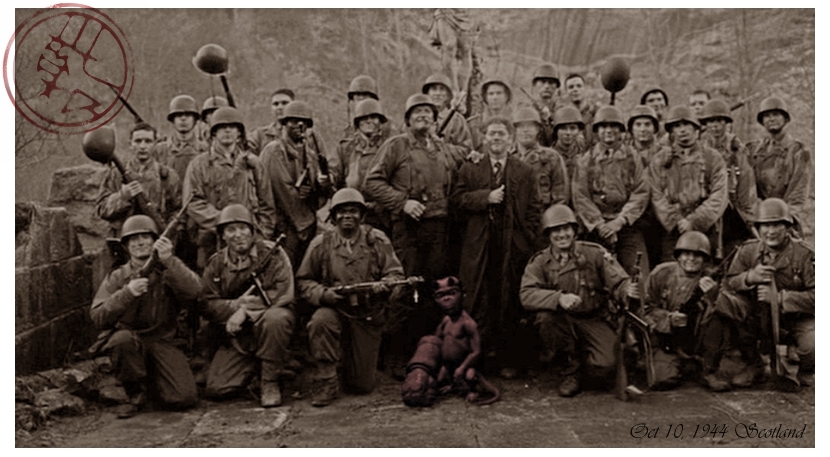
There’s a lot you can do with this idea. Halfway through writing this article I almost deleted half of it to change it to CIA magicians vs. KGB magicians during the Cold War. A World War II pulp adventure game would be really fun too. Sort of like the opening sequence of the original Hellboy film.
Tlaca Codices

The Tlaca People are an amalgamation of inspiration taken from Aztec, Olmec, and Mayan people. The difference is that when the Spaniards arrived the Aztecs were there. The Tlaca people have gone extinct for some reason.

The Aztecs wrote several “codices” in their own language and in Latin and Spanish once the conquistadors arrived. Some of these are in bound book form, others are large sheets of animal skin or plant fibers that have been folded into a small packet.

These codices are a way for players to interact with the story and history of the temple and the history of the world. If they find one as treasure, they can take it back to the Collegio Maximo or to Skigrat Scratchroot who will translate it for them and potentially purchase the item. Some of these codices could also have magical properties (similar to scrolls). This is the sort of forgotten power everyone is searching for.

Tlaca Codices

These books and scrolls offer some of the best insights into the world of the Tlaca people. They are very valuable to researchers like Skrigrat Scratchroot or the historians at the Collegio Maximo.

  1. Book of Medicinal Properties of Various Plants Used by the Tlaca. Describes medicinal herbs, worth 45 gp.
  2. Book of Tributes. A series of house-by-house censuses, worth 25 gp.
  3. Cantares Tlacanos. A collection of Tlaca songs, worth 50 gp.
  4. Ritual Codex. Made of animal skins folded several times. It depicts the rise of the sun god, worth 100 gp.
  5. Prophecies of the Quetzalcoatl. Describes the end of the universe, worth 100 gp.
  6. Codex of the Enlightened Ones. Describes the arrival and history of the Enlightened Ones, worth 250 gp.

lvl 1, room 9: Moleman Library

This room is the makeshift home of a moleman and his stacks of scrolls and books.

Stone Door. This door is locked. The key to all the locked stone doors is in Room 14. Players can use hammers or crowbars to smash the stone doors down. However, doing so may attract wandering monsters. (roll a d6, roll on the wandering monster chart on a 5 or 6).

NPC: Skrigrat Scratchroot. This moleman is a researcher, scribe, and librarian. Years ago, he cleared this space out to serve as his own personal refuge. His attitude towards the players is based upon whether they smashed down his front door or not. He is well versed in reading the hieroglyphs of the Tlaca people and will translate anything for the players.

GM’s Background:Scratchroot is friendly but carries a secret. There is a reason he lives here apart from the other molemen. He craves power and hopes to unlock some of the secret and powerful forgotten Tlaca magic. He has locked away 25 gp worth of gold nuggets and will trade them for Tlaca scrolls or manuscripts.

Skrigrat Scratchroot. HD 1; AC 4 [15]; Atk 1 claws (1d8); Move 6/6 (burrowing); Save 17; AL N; CL/XP 1/15; Special: Blinded by bright light.

Possessions: 6 edible roots, bedroll, and a chest containing 3 Tlaca Codices and 25 gp worth of gold nuggets.

lvl 1, room 8: Spider Den

This room is covered in thick webs. The mummies stored here have been eaten by bugs. Several spiders the size of a person’s hand are crawling through the webs.

Stone Door. This door is locked. The key to all the locked stone doors is in Room 14. Players can use hammers or crowbars to smash the stone doors down. However, doing so may attract wandering monsters. (roll a d6, roll on the wandering monster chart on a 5 or 6).

Webs. Anything in the dense webs moves at half speed and takes a -4 penalty to attack and defense.

Monster. There are 8 of these 1 Ft. Diameter Giant Spiders. They feast on the rodents and other insects that find their way through the cracks.

Giant Spider: HD 1+1; AC 8 [11]; Atk 1 bite (1HP + Poison); Move 9; Save 13; AL C; CL/XP 7/600; Special: Lethal Poison; Webs

lvl 1, Room 7: Store Room

This room has large clay jugs and glass bottles which once held wine and now are filled with foul-smelling vinegar.

Stone Door. This door is locked. The key to all the locked stone doors is in Room 14. Players can use hammers or crowbars to smash the stone doors down. However, doing so may attract wandering monsters. (roll a d6, roll on the wandering monster chart on a 5 or 6).

Treasure. The six clay jugs are worth 25 sp each to the Collegio Maximo. They are full of foul smelling vinegar.

One of the glass jars is shaped like a man with the spout coming out the top of his head. The red liquid smells spicy like cloves or cinnamon. It is a potion of fire resistance.

Review: Inquisitor’s Guide

Inquisitor’s Guide by Marco Bertini

Bertini is an Italian writer who has published several books on the DMs Guild in both English and Italian. Inquisitor’s Guide is great. It reminds me of the articles from Dragon Magazine where they would take a concept and write a multipage article with lore, prestige classes, magic spells, etc. This book is all about bringing the Spanish Inquisition to your game.

Let’s compare what Bertini has done with another Inquisitor, the Inqisitor class from Pathfinder.  The Pathfinder Inquisitor is more like a monster hunter, someone like Van Helsing or Solomon Kane. Someone dealing out justice to monsters with a crossbow, some spells, and a sword. Meanwhile, Bertini’s Inquisitor is more in line with the historical concept of an inquisitor. Someone who is seeking the truth and dealing justice to sinners.

Bertini begins by describing two different flavors of Inquisitor. The first are the Zealots of Tyr who are the more moderate, fight evil defend the weak type of inquisitor. These guys have room for shades of grey in their moral structure. The other is the Holy Order of the Inquisitors. These are also followers of Tyr but more fanatical. They see the world as black or white. You’re either saved or need to be saved. Bertini wrote two pages to these two groups and also provided each with a spiritual text and set of commandments. This is a great tool for roleplaying. If I was playing one of these characters I would quote this stuff all the time. “Truth requires sacrifices that are borne only by the most valiant.” That’s a badass line to say after you stake a vampire.

Next, we have the Sacred Oath called the Oath of Truth. It gives you several abilities tied with investigating the truth like being able to cast detect thoughts and having an Aura of Truth. It’s a solid Oath, if a player brought this to my table I’d be on board. There is also an Inquisitor Background. This is valuable because you wouldn’t necessarily want to use the Acolyte.

Finally, we have tools of torture. Things like rules for Crucifying people, putting them inside an Iron Maiden, etc. These are cool, but not something I would really throw around easily. This is a discussion you want to have with your players. You might have a group of buddies who you’ve known for years and recognize they’ll be fine with this. However, I probably wouldn’t employ these with a group who I don’t know so well like at a convention. First, I feel that players probably shouldn’t be torturing people. There’s a line. It’s ok to intimidate the Kobold and make him fear for his life. It’s not ok to start plucking off some toenails. I feel that torture is like sex in DnD. If it happens it’ll happen off screen. If you have a player that insists on going this route, then there’s going to be consequences. Maybe the Kobold tribe finds the tortured remains of their ally, and they hire a hobgoblin bounty hunter to bring you in for justice.

If the tools of torture are going to show up in my game, it’s going to be used by a villain. The concept of an inquisitor villain is very intriguing. Someone who has captured the Warlock and is torturing them (either explicitly or off screen depending on what you and your table feel comfortable with). The Inquisitor demands the Warlock repent from their evil ways. The villain doesn’t need a complex motivation, they simply believe what they are doing is right.

This archetype would be useful in your Ravenloft or Innistrad game. Another interesting concept would be a historical setting (Europe 16th-17th century) but with fantasy elements (Vampires, werewolves, witches, and curses are all real). This would absolutely be a part of my “Player’s Guide” to that world.

Gameable Product: This book has a new paladin oath, a new background, a new spell, and 11 tools of torture. It also comes with Pre-Generated Paladin Inquisitor (HINT HINT FOR YOUR NEXT VILLAIN). It’s all well done.

Layout and Writing: Bertini’s writing is great, especially when you remember that its translated from Italian. It’s mostly done in the history book voice, but in the back of the book, there are some in character diary entries by an inquisitor. Those probably could have been moved to the front but that’s just being nitpicky. The layout is also very well done. You can tell he either used GMBinder or some other template to do it and it looks great.

Artwork: Bertini uses a lot of good artwork available on the DM’s Guild. The cover is a really cool renaissance painting by Caravaggio. He does a great job with the art, but remember, artwork means nothing to me. That’s not why I want you to buy a DMs Guild product. No one should be docking a book points because of the lack of artwork.

Bertini’s Inquisitor’s Guide is 13 pages long for $1.95. That’s a very fair price if you’re interested in this type of character or the campaign in which this type of character will thrive. That’s less than a cup of coffee. I give this book 5 iron maidens out of 5.

lvl 1, Room: 6

This room has rotting wooden shelves with clay ornaments on display.

Stone Door. This door is locked. The key to all the locked stone doors is in Room 14. Players can use hammers or crowbars to smash the stone doors down. However, doing so may attract wandering monsters. (roll a d6, roll on the wandering monster chart on a 5 or 6).

Treasure: There are several clay ornaments on display here. Some of them are small figurines sculpted in the form of warriors and animals. There are 12 figurines worth 1 gp each to collectors. The Collegio Maximo is also interested in purchasing these types of artifacts. However, these figurines are fragile. If a creature scores a critical hit against a player carrying them, then the figurines will break.  

Review: Monster Loot Vol. 1

Monster Loot Vol. 1- Monster Manual by Anne Gregersen

Anne Gregersen is an authoer I’ve seen on the DM’s Guild. She’s several best selling modules and I highly recommend that you check them out. She did something in Monster Loot that I think every DMs Guild creator should do. She included pictures of covers of several of her books with clickable links to go find them. Everyone should be doing this. It drives people to your content. Let me tell you, nothing makes me feel better than when I check my royalties to see someone bought 1 of each of my books. I know that when my Shinobi book makes a sale, it did so because someone saw it in one of my other books.

The Content

This book offers rules for harvesting monsters (your players are going to make a skill check) and then proceeds to give you 3-7 things to be harvested for every monster in the monster manual. Sometimes its as simple as 2-3 rations (mmmmm fresh meat!) and sometimes it’s something more interesting. How about Vials of Aboleth Mucus, a Intellect Devourer Brain Chunks, or a set of Harpy Vocal Cords? My only request would be to take this further. What about Nothic Liver? A Polar Bear’s liver is so toxic it will kill you. I wanted some weirder items.

For good or bad, I would have done it a little different. Instead of bullet points I would have done charts where the higher the DC the player rolls on their Harvest Check the more valuable the harvest. That’s very gamey. What Gregersen has done is better for story. When you’re harvesting an animals fangs or liver you just pull it out. You don’t go “well guess I’ll just be satisfied with these claws…”

This book gives you a lot. This is perfect for low magic settings. You don’t want your players just finding magic items. You want them to harvest creatures and forge a sword that is magical because it comes with a dragon fang on the hilt! This would be amazing for a prehistoric campaign, bronze age campaign, or a post apocalyptic campaign. I’ve done this in games before where you can harvest parts of an animal and go on weird quests. I could also see a druid or warlock subclass who specializes in haruspicy, or the reading of entrails.

Here’s the thing about this book. The first time you use it on your players ask them: “Do you want to harvest the Oni? Roll the dice” then you give them a pair of Oni Teeth. I guarantee you they will want to harvest every monster they fight from that point on. This is how you make your campaign into Monster Hunter or Kingdom Death. Your players will be “I’ll save the bottle from this health potion incase I need to scoop up some Gray Ooze Goop later.”

Finally, this book is useful regardless of what edition you’re playing. It says its for 5th edition but anyone playing OSR, 3rd Edition, or Pathfinder will find a use for this book.

Layout

This is the hard part publishing DnD modules. Coming up with the ideas is easy. Writing them down is tricky. But doing layout that looks professional and lush is hard. Gregersen goes for a dark cobalt blue look. One thing I like about the book is that it designed to look like an ancient tomb of eldritch lore, similar to some of the books from 3rd edition. I think this template turned out nicely.

Artwork

This is a tricky one. I cannot blame Gregersen for the lack of artwork. Artwork is expensive, at best DMs Guild creators are going to have to buy stock art or use the free art Wizard’s has made available (some of that stuff is worthless. They cropped artwork weird rendering it useless). If she had put in a ton of artwork in this you’d be looking at a book that would cost twice as much. Original artwork in a DMs Guild product is cool, but I’m more interested in content.  

Monster Loot is 81 pages long and costs $4.95. That means she’s only charging you $.06 a page. That’s a steal for how much you can get out of this book if you use it. It’s absolutely worth purchasing. I give it 4.5 giant toes out of 5.

lvl 1, room 5

This room has small alcoves carved out of the wall with skeletal remains laid to rest. A thick layer of dust covers everything.

Monster: Turquoise encrusted skeletons, their joints are held together with gold wire. Disturbing this room makes 6 skeletons come to life.

Turquoise Encrusted Skeleton: HD 1; AC 8 [11]; Atk 1 strike (1d6); Move 12; Save 17; AL N; CL/XP 1/15; Special: Immune to sleep and charm spells.

Treasure: The turquoise and gold chips can be scraped off the bones and sold for 50 gp.

lvl 1, room 4: Vestment Storage Room

The stone door to this room is locked. This 15’ by 15’ room was used by the priests as a store room for religious vestments and implements.

Stone Door. This door is locked. The key to all the locked stone doors is in Room 14. Players can use hammers or crowbars to smash the stone doors down. However, doing so may attract wandering monsters. (roll a d6, roll on the wandering monster chart on a 5 or 6).

Treasure. Whatever the clay pots once held has now dried up over the ages. There are 6 small pots worth 5 cp each to the Collegio Maximo.

On the shelf is an obsidian dagger which counts as a magic weapon for hitting ghosts and other incorporeal enemies.

Also in the storage room is several sets of priest’s robes. These are made from thin dried linen. Along with these robes is a beautiful stone mask made from turquoise, gold, and brilliant feathers. The mask is nonmagical and worth 350 gp. However, the ghosts and specters in this dungeon will not attack anyone wearing the mask.